
5 Stages of Healing After Betrayal Trauma: A Definitive Guide
← Back to the Betrayal Recovery Learning Centre
When you're in the middle of a crisis, you don't need a two-year plan. You simply need to get through the next hour. The days following a discovery are often a blur of hyperarousal and emotional numbing. You may feel like you're losing your mind trying to piece the timeline together only to find yourself staring at a wall for hours. This isn't a sign that you're weak. It's a sign that your world has been fundamentally altered. This guide is part of our Betrayal Recovery Learning Centre, designed to help you stabilize and find clinical clarity after discovery.
Understanding the 5 stages of healing after betrayal trauma provides a necessary framework for your recovery. While these stages aren't linear, they offer a way to make sense of the internal chaos. At Betrayal Care, we focus first on the person who was betrayed rather than the spouse who committed infidelity. This ensures your recovery is grounded in your own stability regardless of the relationship's potential future.
Healing isn't about "getting over it." It's about integrating a painful truth into a new, more honest version of your life. This guide will walk you through that process, from the first hour of shock to the long term building of a life that truly belongs to you.
In this article
Why Betrayal Healing is Different from Traditional Grief
1. Surviving Right Now (Stage One: Stabilization)
2. Making Sense of What Happened (Stage Two: Sense-Making)
3. Finding Yourself Again (Stage Three: Identity Reclamation)
4. Deciding What Comes Next (Stage Four: Discernment)
5. Building What Comes After (Stage Five: Integration)
Accessing Specialized Recovery Support in Canada
Why Betrayal Healing is Different from Traditional Grief
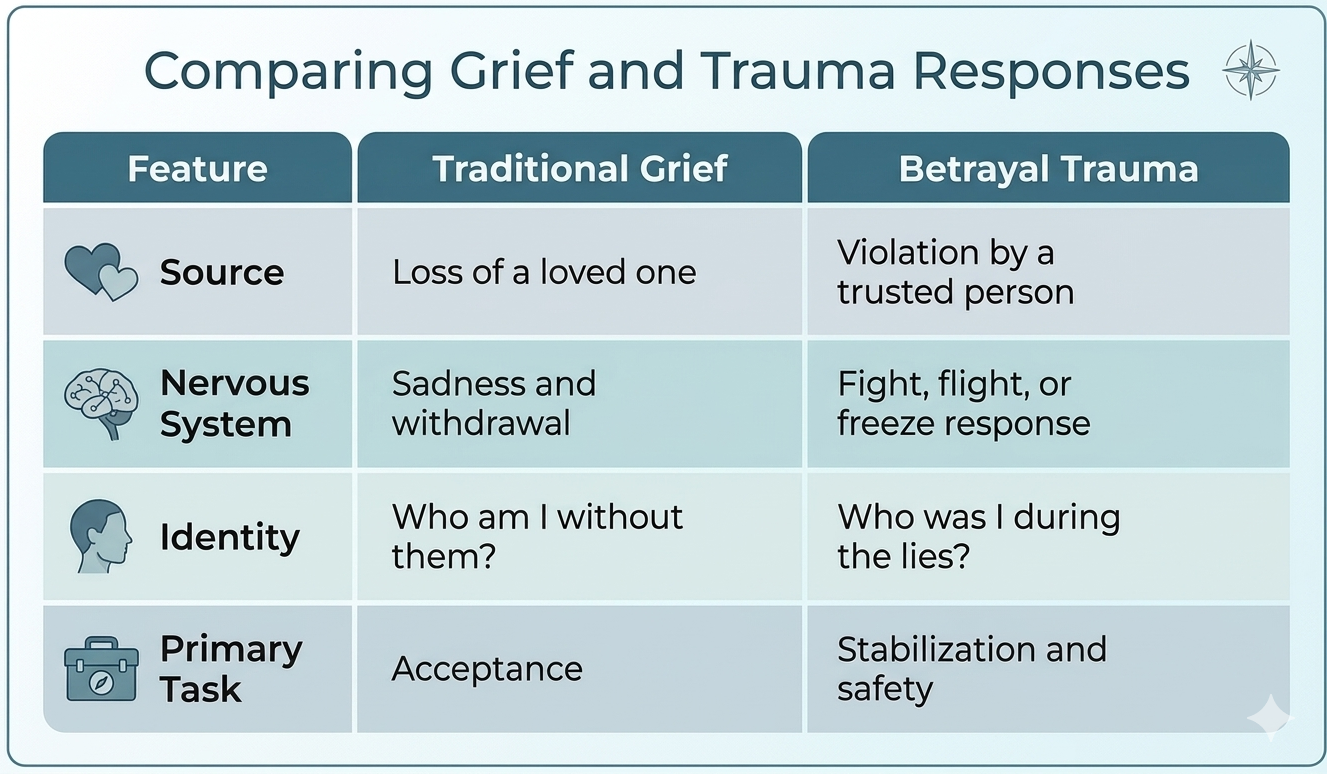
Most people are familiar with the standard stages of grief. You might expect to feel denial, anger, and sadness. However, betrayal trauma is distinct because it involves a "shattered reality" component. You aren't just grieving a loss. You're re-evaluating your entire past. You're asking yourself if the last five, ten, or twenty years were a lie.
This creates a specific type of psychological injury called an attachment injury. When the person you rely on for safety becomes the source of your danger, your brain enters a state of deep conflict. Your "logic center" wants to understand, while your "survival center" wants to run. This guide is designed to help those two parts of your brain start talking to each other again.

1. Surviving Right Now (Stage One: Stabilization)
When the shock is still fresh and getting through the next hour feels like enough, this is where to begin. Your mind may be racing or your body may feel completely shut down. Both are normal responses to betrayal trauma. You don't need to have it all figured out today. You just need one next step.
The Neurobiology of Survival
In the state of shock, your amygdala is in control. This part of the brain is responsible for survival. It categorized the betrayal as a life threatening event. This is why you feel a physical "weight" or "sting" in your chest. Your prefrontal cortex, the part of the brain that handles logic and long term planning, has essentially gone offline to save energy for survival.
The 24 Hour Rule and Temperature Shocks
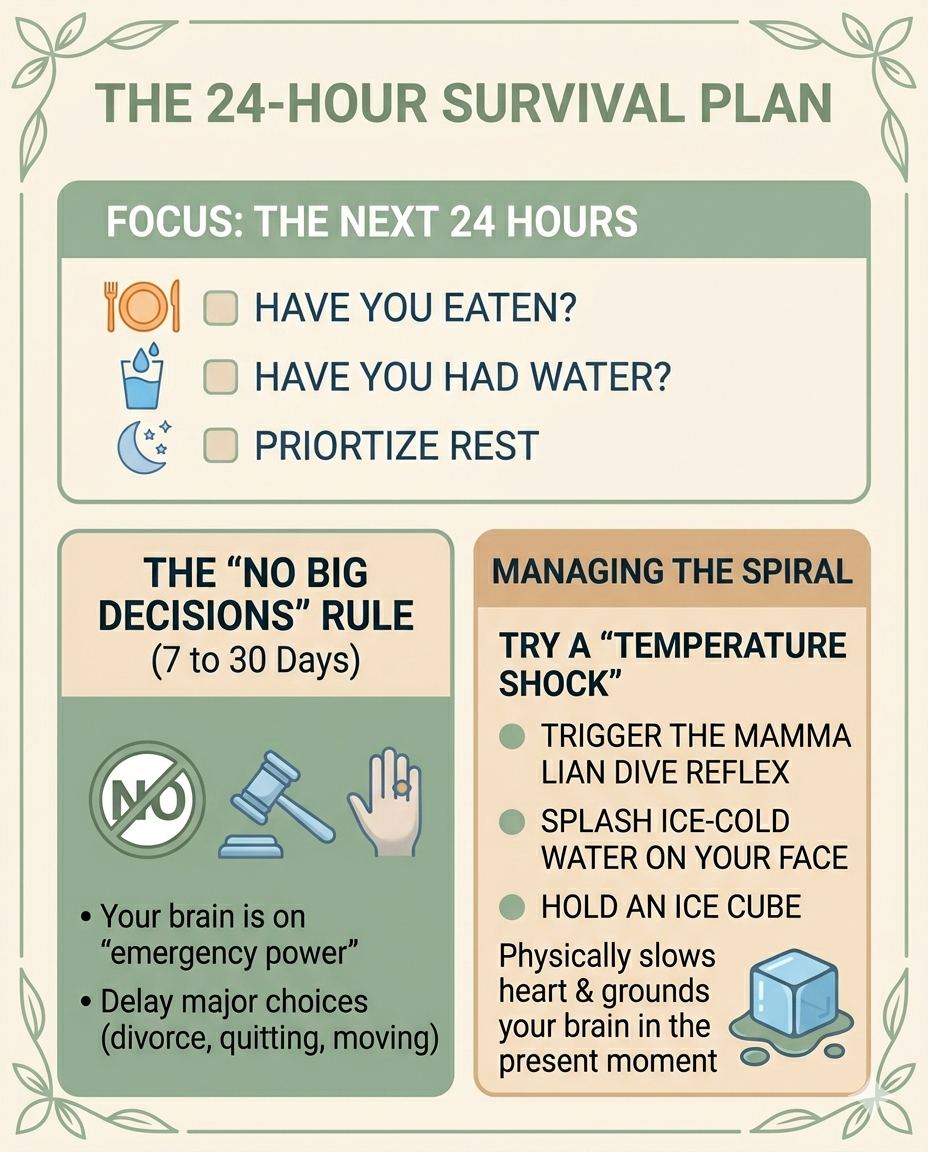
In this stage, we focus on "The 24 Hour Rule." Don't look at next month. Look at the next twenty four hours. Have you eaten? Have you had water? If your heart is racing and you can't stop the spiral, try a "Temperature Shock." Splashing ice cold water on your face or holding an ice cube can trigger the "mammalian dive reflex." This physically forces your heart rate to slow down and brings your brain back into the present moment.
Safety and Boundaries
Safety First: If you're in a situation involving physical harm or you feel unsafe, your immediate priority is finding space and safety to process. Healing cannot begin in an environment of active danger.
The Decision Rule: Implement a "no big decisions" rule for at least the first seven to thirty days. Your brain is currently operating on "emergency power." This isn't the time to file for divorce, sell the house, or quit your job. Give your nervous system time to move out of acute shock before you choose your future.
Further Steps for Surviving Right Now:
Understand why your body feels like it's hurting and the physical impact of trauma.
Learn how to manage mind movies and stop the cycle of intrusive thoughts.
2. Making Sense of What Happened (Stage Two: Sense-Making)
Something was hidden from you, and now you're questioning everything you thought you knew. What was real. What wasn't. Whether you missed something. This section is for people trying to understand how betrayal trauma works and why it affects the mind and body the way it does.
The Information Gap
You might find yourself obsessing over the details. You want to know the "who, what, when, and where." This isn't because you're "crazy" or "obsessive." It's because of "The Information Gap." Your brain hates unsolved puzzles. It's trying to fill in the blanks so it can assess the true level of danger. Understanding this can help reduce the shame you feel for "investigating" your partner.
Cognitive Dissonance and Gaslighting
The most painful part of this stage is the cognitive dissonance. You're trying to reconcile the "Kind Partner" you knew with the "Hurtful Partner" who cheated. If there was gaslighting involved, you're also fighting to trust your own memory. You aren't losing your mind. You're recovering from a period where your reality was intentionally distorted.
The Clinical Task: Trauma Informed Sense-Making
Trauma informed sense-making is the priority here. You're beginning to realize that your symptoms, the hypervigilance and the constant questioning, aren't signs of a breakdown. They're logical responses to a shattered sense of safety.
Common Pitfalls:
Many people try to jump straight into marriage counselling here. However, skipping individual stabilization often leads to further trauma. If the partner is still lying or "trickle truthing," couples counselling can actually be harmful. It's vital to understand the difference between betrayal trauma therapy and couples counselling before booking a joint session. Once the truth is fully out and you feel stable, infidelity counselling for couples can become a constructive part of repair.
Further Steps for Making Sense of What Happened:
Understand the specific wounds and healing process for emotional betrayal.
Get a realistic clinical timeline on how long it takes to heal from infidelity.
Learn how to vet and find a qualified betrayal trauma therapist.
3. Finding Yourself Again (Stage Three: Identity Reclamation)
Betrayal doesn't just shake a relationship. It shakes your sense of who you are, what you deserve, and whether your own instincts can be trusted. Rebuilding your identity after betrayal trauma isn't about going back to who you were before. It's about reconnecting with yourself on steadier ground.
The Mirror Effect
Betrayal often creates a "Mirror Effect." You see yourself through the lens of your partner's choices. You might think, "If I were enough, they wouldn't have done this." This is a distortion. Their choices are a reflection of their character and coping mechanisms, not your value. Part of this stage is cleaning that mirror so you can see your true self again.

Micro-Agency and Self Trust
Healing requires "Micro-Agency." This means making small, autonomous choices that are 100% for you. What coffee do you actually like? What music makes you feel grounded? What book do you want to read? By making these tiny decisions and honoring them, you're slowly re-parenting your intuition and rebuilding self trust.
The Focus Shift:
In this stage, the focus shifts from the partner's actions to your own internal world. You're learning to separate your pain from your identity. You're a person experiencing an injury, not a broken person. You're moving from a reactive state to an active state.
Further Steps for Finding Yourself Again:
Reconnect with your vision and learn how to start feeling like yourself again.
Build internal security by learning how to trust again after being cheated on.
4. Deciding What Comes Next (Stage Four: Discernment)
Stay or leave. Rebuild or release. These are some of the hardest decisions a person can face and there's no exact timeline you're supposed to follow. Only after you've regained some sense of self can you effectively begin the process of choice.
Values vs. Fear
When you're deciding what comes next, it's important to distinguish between "Fear Decisions" and "Values Decisions." A fear decision is staying because you're afraid of being alone or leaving because you're afraid of the pain. A values decision is choosing a path because it aligns with your integrity, your self respect, and your vision for a healthy life.
Decision Fatigue and Chronic Uncertainty
It's normal to feel decision fatigue. You might change your mind five times a day. This is a sign that you still need more time to stabilize. There's no "correct" choice that works for everyone. The only "right" choice is the one you can live with long term without losing yourself..
The Goal of Clarity:
This section isn't here to tell you what to decide. It's here to help you get honest with yourself so that when clarity comes, you recognize it. You're now operating from a place of empowered discernment rather than panic. You're looking at the relationship with clear eyes, seeing both the potential for repair and the reality of the damage.
Further Steps for Deciding What Comes Next:
Use a values based framework to decide whether to stay or leave after cheating.
5. Building What Comes After (Stage Five: Integration)
This isn't about returning to who you were before the betrayal. That version of your life is in the past and that isn't a failure. It's a starting point. This section is for people who are ready to build something that actually belongs to them. You've integrated this experience into your story in a way that no longer defines your entire existence.
The Kintsugi Philosophy
In Japan, there's an art form called Kintsugi. When a piece of pottery breaks, they don't throw it away or hide the cracks. They repair the cracks with gold. The result is a piece that's more beautiful and stronger for having been broken. Your life after betrayal can be a version of Kintsugi. The scars don't have to be hidden. They can be the very things that make your new life more valuable and durable.

Post Traumatic Growth
You aren't just getting back to normal. You're moving into "Post Traumatic Growth." This is the psychological reality where people who survive a crisis often develop a deeper sense of self, a greater appreciation for life, and a more robust set of boundaries. You're no longer just surviving. You're moving forward with a deeper connection to your own intuition.
What Integration Looks Like:
It's a life grounded in clarity, self-trust, and real stability. You've moved from being a victim of circumstances to an agent of your own healing. You can look at the past without being swallowed by it, and you can look at the future without being paralyzed by it.
Further Steps for Building What Comes After:
Learn how to transition from brokenness to post traumatic growth.
Build a personal constitution by setting boundaries after infidelity.
Prepare a long term resilience plan for navigating betrayal triggers years later.
Accessing Specialized Recovery Support in Canada
Healing through these stages is a heavy burden to carry alone. Whether you're in the initial shock or the deep work of identity reclamation, professional guidance helps you navigate the clinical path more effectively. You don't have to guess what the next step is.
The Betrayal Care Team consists of betrayal trauma therapists who offer virtual therapy for Canadians in British Columbia, Alberta, Ontario. For those on the West Coast, our betrayal trauma therapy in Vancouver walks through what this support looks like. We adhere to high clinical standards to ensure you receive the specialized care you deserve. We focus on healing the individual first and will provide a clear map moving forward.
Would you like to take a small step forward today? Book a free consultation to speak with one of our therapists. You deserve a path forward that's defined by your own values and your own timeline.
← Back to the Betrayal Recovery Learning Centre to explore more resources